


Printing INKS
Our Specialization

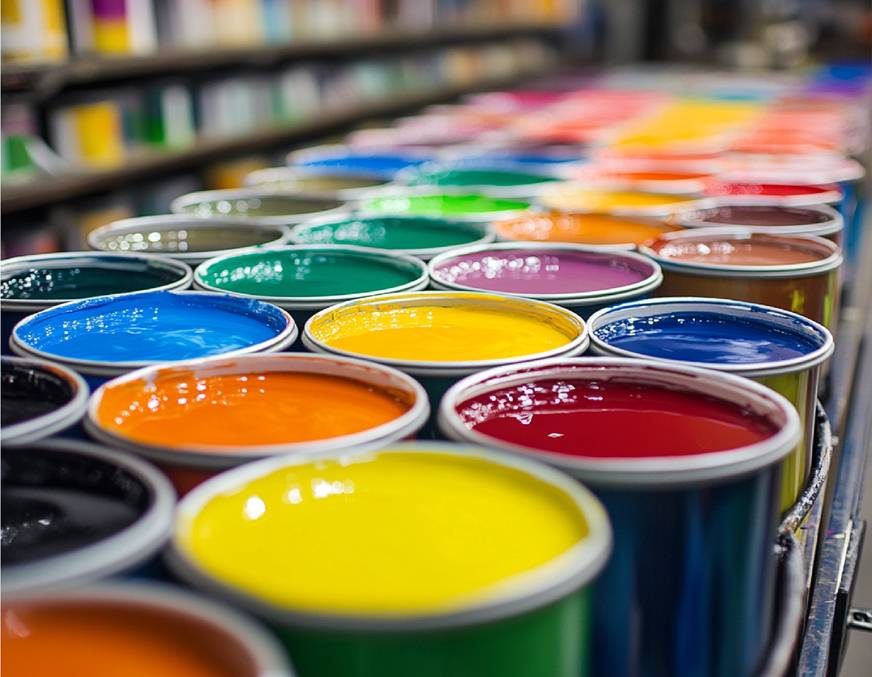
Pioneer Manufacturers, Specialized in producing Water Based Inks specially for knitted and wooven fabrics.

Research & Development

Our state-of-the-art R&D facility is among the most advanced and all our products are developed by our own R&D.

Quality Materials

Our working concept is to develop and provide the best quality products to our customers after continuous experiments and strict quality control.

One Stop Solution

Textile Printing Inks

Our Mission & Vision

FORMULATE

Every great product begins with a vision—and a formula. Our team of expert chemists and textile specialists crafts innovative ink solutions tailored to the unique needs of the textile printing industry. We focus on precision, consistency, and vibrant results that bring your designs to life.


OPTIMIZE

Innovation doesn’t stop at formulation. We continuously refine our inks for performance, sustainability, and efficiency. By rigorously testing every batch and staying ahead of industry trends, we ensure that our inks not only meet but exceed expectations in color fidelity, durability, and environmental responsibility.

EXECUTE

From concept to production, we ensure flawless execution. Our inks are designed for seamless integration with modern textile printing processes, delivering reliable results every time. We partner with our clients to turn ideas into tangible, high-quality textile prints that make an impact.

At KARAN, we don’t just provide inks—we provide a promise of quality, innovation, and reliability for every textile project.

39

Years Completed

30

+

Certified Products

1000

+

Satisfied Clients

A partner, Not A Vendor:
Our Blog Corner

The Textile Knowledge

Help & Support

Screen Printing Troubleshooting Guide.

Common problems faced by printers — solutions provided by Karan Texchem based on expert knowledge.

Precaution: Avoid overprinting with extra strokes, as ink build-up may result in tackiness in print.

Solution: Use high-opacity white ink like Texaprint K2S / Texaprint KB. Check ink viscosity; if loose, add 1–2% thickener under stirring. If possible, use a lower screen mesh like 100 mesh/inch for better ink deposition on fabric.

Precaution: Avoid using binder for dilution, as it may differ from the binder already used in the ink and cause inconsistency.

Solution: Add 2–3% water under stirring, or add diluted glacial acetic acid to bring the ink to the correct working viscosity.

Precaution: Avoid using binder or any other auxiliaries that may cause premature mesh clogging.

Solution: Add 2-3% of retarder - Hemaprint NCR to the ink. This keeps the screen open longer and prevents drying in the mesh during production runs.

For standard black printing on any base, always use a ready black ink like Texaprint Black HS for consistent opacity and runnability. For high-stretch fabrics such as lycra or elastane blends, use Texaprint KL or Texaprint KBL — these inks flex with the fabric without cracking or peeling.

For opaque or heavy white inks on dark fabrics, use a coarser mesh around 100 mesh/inch for maximum ink deposition. For fine-detail prints, use a higher mesh count (140–160 mesh/inch). Always match mesh count to your ink viscosity and design complexity.
ESTABLISHED SINCE 1987
INNOVATIVE CUSTOMIZED SOLUTIONS
QUALITY MATERIALS AND SPECILIZED SOLUTIONS
TECHNICAL EXPERTISE
SUPERIOR QUALITY, DURABILITY AND CONSISTENCY